



** NGN News Network
If a child can reproduce every answer in an examination but cannot use that knowledge in real life, what has the child truly learnt?
Imagine two students who score equally well in Science. Asked to explain a familiar concept in a new situation, one repeats the textbook definition; the other reasons it out and applies the idea. Both have scored well. Have both understood equally well?
When Marks Tell Only Half the Story
Marks matter. They reflect effort, achievement and progress. But they cannot tell the whole story of a child’s learning. A student may memorise information for an examination without understanding how to use it independently.
Memorisation has its place: children need facts, vocabulary and foundational knowledge. The problem begins when remembering becomes the destination rather than the starting point. Real learning means understanding an idea, asking questions about it and applying it wisely.
Can Children Use What They Learn?
A child may solve familiar mathematical problems yet struggle when the same principle appears in an unfamiliar situation. Another may write an essay on protecting the environment but fail to connect its message with everyday choices.
These examples raise an important question: Are children learning to think, or simply learning to reproduce answers?
Understanding grows when students ask why, examine evidence, compare possibilities and explain their reasoning. Discussion, experiments, observation and practical tasks help them connect classroom knowledge with the world around them. Even an unexpected question can signal curiosity—not distraction.
The Classroom and Home Must Work Together
Schools need not compromise academic standards to make learning meaningful. Teachers can ask students to explain how they reached an answer, connect concepts to real situations and learn from mistakes. Assessment should reveal gaps and guide improvement, not merely rank children.
Parents can help, too. Instead of asking only, “How much did you score?”, they might ask, “What surprised you today?” or “Where could you use what you learnt?” Such questions invite children to explain ideas in their own words and build independent thinking.
A lower score does not automatically mean a child lacks ability. It may point to a gap in understanding, ineffective study strategies or a need for support. The useful response is to identify the difficulty and help the child move forward—not compare or label.
Beyond the Report Card
Education must prepare children not only for examinations, but also for decisions, relationships, responsibilities and a changing world. Knowledge is essential; so are judgement, communication, empathy, adaptability and the willingness to keep learning.
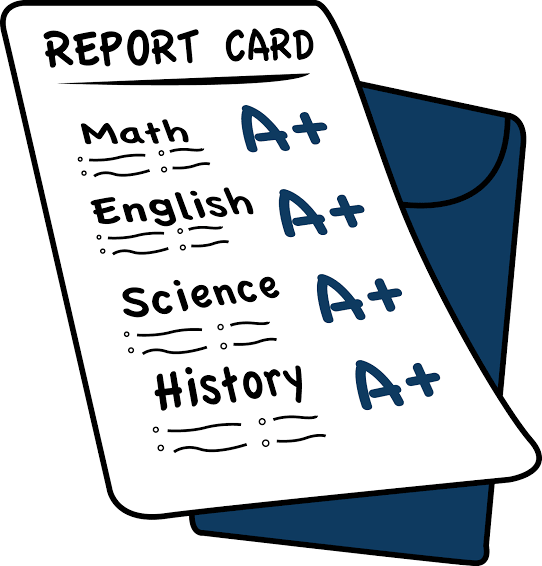
A report card records performance at one point in time. It cannot, by itself, show how a child will approach an unfamiliar problem, consider another viewpoint or use knowledge responsibly.
The answer is not to dismiss marks. It is to see them in perspective and broaden our understanding of success. Academic achievement and meaningful learning should strengthen each other.
The real question is not simply whether children can produce the right answers, but whether they can think when the answers are not already given.
That is when education moves beyond examination success and begins to fulfil its true purpose.
– Durga Deepak
Lead Educational Consultant
Edubridge Consulting l
9011009794

Comments are closed.